Artist Residencies in Estes Park
1 residencyin Estes Park, United States
Why Estes Park works for residency life
Estes Park sits at the eastern gateway to Rocky Mountain National Park, and that shapes almost everything about doing a residency here. You get daily access to high-elevation light, fast weather changes, wildlife, and dramatic views, plus a tourism-driven town that actually cares about art because visitors buy it.
For artists, the attraction is pretty specific:
- Landscape and ecology as subject matter – If you’re painting, photographing, writing, composing, or working with sound, the park will fill your sketchbooks and hard drives fast.
- Public-facing practice – Many programs here build in talks, workshops, or open studios. If you want to test your work with real audiences (families, hikers, retirees, rangers), this is a good place.
- Compact but active scene – It’s not Denver, but for a small town you get galleries, community art spaces, and institutions like the Rocky Mountain Conservancy and YMCA of the Rockies.
If your practice thrives on big-city density, this will feel quiet. If you’ve been hungry for uninterrupted time with strong place-based input, Estes Park can be exactly right.
Rocky Mountain National Park Artist-in-Residence
The Rocky Mountain National Park (RMNP) Artist-in-Residence program is the signature residency in Estes Park and one of the most recognized park residencies in the U.S.
What the residency actually looks like
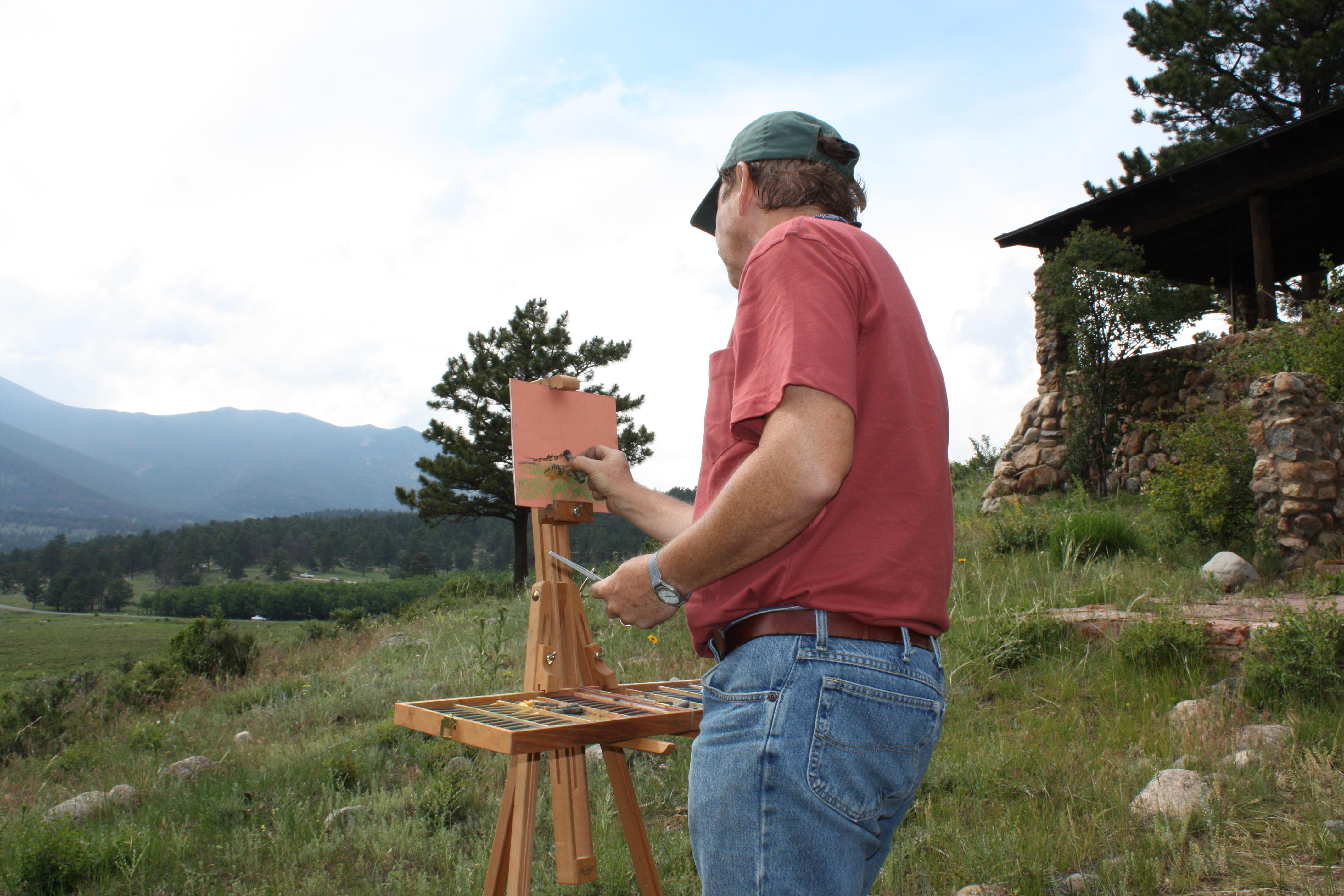
The program is run by Rocky Mountain National Park in partnership with the Rocky Mountain Conservancy. Selected artists live in a historic cabin on the east side of the park, near Moraine Park, for about two weeks during the warmer months.
Key features:
- Length: Two-week residencies, typically scheduled between late spring and early fall.
- Housing: A rustic historic cabin inside the park. You’re close to major trailheads and Moraine Park, not downtown nightlife.
- Disciplines: Very broad. Past artists have included painters, photographers, composers, textile artists, sculptors, writers, poets, musicians, and performers.
- Public programs: Each artist generally offers two public events: one lecture-style talk and one interactive, drop-in session with a hands-on or conversational component.
- Donation requirement: At the end, you donate a finished work inspired by your residency to the Rocky Mountain Conservancy’s collection, with usage rights held by the Conservancy and sharing rights by the National Park Service.
- Stipend: Some years offer a modest stipend; some do not. Do not assume funding—always check the current cycle details.
The residency is not about hiding in the cabin and ignoring visitors. You’re creating work in dialogue with the park, then sharing that process and a piece of the results with the public.
Who this program serves best
This residency is a strong fit if you:
- Work directly with landscape, ecology, climate, or place-based research.
- Like or at least tolerate structured public engagement—talks, demonstrations, casual conversations with visitors.
- Can produce new work in a two-week window or at least a significant, resolved piece by the end.
- Are comfortable in simple, rustic housing and don’t need city amenities on hand.
It’s less ideal if you need large fabrication equipment, media-heavy production facilities, or long solo stretches without having to interact with anyone.
Working conditions and logistics
Daily life at RMNP AIR has its own rhythm:
- Space & studio: You typically work out of the cabin or in the landscape. There’s no big industrial shop, so plan for portable, low-tech, or digital setups.
- Supplies: You bring your own core materials. Some public program materials may be supplied by the park, but don’t rely on that for your actual artwork.
- Access to town: Estes Park is the nearest town for groceries and supplies. Having a car makes things vastly easier.
- Weather: Expect fast shifts—heat, hail, afternoon storms, cold mornings, sometimes smoke from regional fires. Build flexibility into your work plan.
Because you’re donating a finished work at the end, plan your project backwards: what can you realistically conceive, create, and finish in two weeks, with some time earmarked for public programs and weather delays?
How to approach the application conceptually
When you’re building a proposal for RMNP AIR, focus on:
- How your work responds to this specific park—not just “nature” in general. Think geology, soundscapes, visitor culture, trail systems, conservation history.
- Community interaction ideas—what could you do in a lecture and a drop-in program that feels genuine to your practice?
- What you’ll donate—outline the kind of work you’ll leave with the Conservancy, both conceptually and materially.
The staff and selection panels see a lot of landscape-adjacent proposals. Clear, research-informed ideas about RMNP itself tend to stand out.
YMCA of the Rockies – Estes Park Center Artist-in-Residence
The other anchor program in Estes Park is the Artist in Residence initiative at the YMCA of the Rockies’ Estes Park Center. The YMCA campus is a large, functioning retreat and conference center with lodging, programming spaces, and open grounds, set just south and west of town.
How the YMCA residency differs from RMNP AIR
Even though they share the same general landscape, the two residencies feel very different in practice:
- Setting: RMNP AIR places you in a relatively isolated cabin within the national park. The YMCA residency puts you on a busy, multi-use campus with families, groups, and ongoing programs.
- Community: At the YMCA you’re surrounded by people constantly—campers, retreat groups, staff. This suits artists who like accessible, everyday interaction.
- Infrastructure: The campus typically offers more built amenities than a park cabin environment, and it’s easier to reach town for supplies.
- Focus: The YMCA leans more towards community engagement and family-friendly programming; RMNP AIR foregrounds landscape and conservation context.
Both can be valuable, but they shape very different bodies of work.
Who thrives at the YMCA program
This residency tends to support artists who:
- Are comfortable working around people and integrating art into everyday campus life.
- Want opportunities for workshops, informal concerts/readings, or youth engagement.
- Appreciate having a structured, serviced environment instead of a remote cabin.
- Work in music, writing, visual art, or performance that can adapt to multi-purpose spaces (meeting rooms, chapels, outdoor platforms).
Terms can shift from year to year, so always check the current cycle for details on housing, expectations, stipends, and length.
Planning your project for a campus-style residency
On a large campus like the YMCA, you can design projects that are harder to pull off in a wilderness cabin:
- Participatory pieces – collaborative quilts, songwriting workshops, oral history mapping, community drawing sessions.
- Serial work – portraits of staff, daily sketches of different corners of the campus, audio compositions built from ambient sounds.
- Family-accessible installations – pieces that invite quick engagement from kids and non-art audiences.
If your practice naturally flexes between studio work and public-facing experiments, this environment gives you a lot of material and participants to work with.
Living and working in Estes Park as an artist
Residencies here solve a big part of the cost problem by providing housing, and sometimes a stipend or teaching fee. If you’re planning pre- or post-residency time or thinking about a longer stay, it helps to understand how the town functions.
Costs, housing, and staying on beyond the residency
Estes Park is a resort town, which usually means:
- Housing is expensive and tight, especially in summer and early fall.
- Short-term rentals cost more than many larger cities’ off-season rates.
- Groceries and basic services are available but not cheap, and options are limited compared with a metro area.
If you’re extending your stay outside of residency housing, a few tactics help:
- Look early in surrounding areas like Lyons or Drake for more affordable options, accepting a commute.
- Coordinate with other artists to share housing for a short stretch, especially shoulder seasons.
- Budget for peak-season pricing even if you think you’ll be there in a “quiet” window—weather, events, and park visitation can push demand up quickly.
Studios, tools, and materials
Estes Park doesn’t have a deep warehouse district full of studios. Most artists rely on:
- Residency-provided workspaces.
- Home or temporary studios.
- Multi-use rooms and galleries for short-term setup.
If your work needs heavy fabrication, specialized printmaking presses, a full ceramics setup, or large-scale woodworking, you’ll need to plan around that. Either scale your work to what you can transport and set up in a modest space, or treat the residency as research and sketch phase rather than production of large final pieces.
For smaller-scale or digital practices (drawing, painting, photography, sound, video editing, writing), the infrastructure is usually enough, especially if you bring what you need and keep your footprint manageable.
Galleries and showing your work
Estes Park’s gallery ecosystem tracks closely with tourism. Visitors come for the views and often leave with images of them.
Commonly seen and sold locally:
- Landscape painting and photography featuring Rocky Mountain National Park.
- Wildlife art – elk, bighorn sheep, bears, birds.
- Jewelry, ceramics, and fiber with a regional or natural motif.
- Small and mid-scale works that can travel easily.
Places to pay attention to include downtown galleries along the Riverwalk area and shops focused on regional fine art and photography. While residencies like RMNP AIR don’t function as commercial gallery programs, they do plug you into this local ecosystem. Public talks and open studios often draw people who buy art elsewhere in town or follow you later online.
If selling work on-site is part of your plan, focus on pieces that are:
- Portable,
- Durable for travel,
- Clearly tied to the Estes Park / RMNP experience.
Getting there, getting around, and picking your season
You won’t get far in Estes Park without thinking about transportation and timing.
Transportation basics
Estes Park is car-centric. There’s road access from the Front Range, and the drive from Denver is roughly one and a half to two hours, depending on route and traffic.
Once you’re in town:
- Walking works for downtown and some neighborhoods.
- A car is extremely useful for getting to Rocky Mountain National Park trailheads, supply runs, and dispersed housing.
- Seasonal shuttles and park transit do exist, but they don’t fully replace having your own transport, especially with gear.
If you’re flying in and can’t drive, coordinate carefully with the residency host about how you’ll move yourself and your materials between the airport, town, campus, and park.
When to be there as an artist
The season you choose shapes your work as much as the residency program itself.
- Late spring to early summer: snow still on high peaks, rivers running strong, early flowers, shoulder-season crowds. Great for dynamic weather and fresh greens.
- Late summer to early fall: stable weather, clear light, elk rut, fall colors. Also peak tourist season, which can be useful if you want more public interaction.
- Winter: quieter, colder, and logistically more demanding. Amazing if your work is about starkness, snow, or slowed-down human activity.
When you apply, request windows that match your project. For example, if you’re recording soundscapes, you might aim for a shoulder season to avoid constant crowd noise. If you want to experiment with public programs, high-season dates can make sense.
Community, visas, and picking the right fit
Estes Park’s art community is small, but very cross-connected between park staff, the Conservancy, YMCA programming, and local galleries. A residency here often leads to relationships that outlast your stay.
Local arts ecosystem
Useful anchors to know and follow:
- Rocky Mountain Conservancy – supports the RMNP Artist-in-Residence and manages the donated works collection.
- Rocky Mountain National Park – public programs, talks, and residency announcements.
- YMCA of the Rockies – information on their Artist in Residence program and related events.
- Downtown galleries and art centers in Estes Park – for potential connections, local sales, and community shows.
Residency public programs often attract locals, repeat park visitors, and staff. Treat those events as both research and soft networking.
Visa and international artist considerations
For U.S.-based artists, residencies here function like any other domestic program. For international artists, the picture is more complex.
Questions to ask the host organization early:
- Is the program open to non-U.S. residents this year?
- Does it include a stipend, honorarium, teaching fee, or sales opportunities organized by the host?
- What kind of public activities are expected—are you just giving talks, or is there structured paid teaching?
- Can the organization provide a formal invitation letter describing the nature and dates of the residency?
The right visa category depends on the specifics of your case, your country of origin, and whether money is changing hands. When in doubt, speaking with an immigration professional is a smart move before committing to dates.
Deciding if Estes Park is right for you
Estes Park residencies generally make sense if you:
- Work with landscape, ecology, or place in a substantive way.
- Want at least some public interface built into your residency.
- Are okay trading big-city cultural density for deep immersion in a single environment.
- Can adapt your scale and materials to modest studio setups.
If you need 24/7 access to fabrication labs, a thick scene of openings every night, and abundant cheap housing, this probably isn’t your spot. But if you’re ready to center your practice around one mountain town and one national park for a concentrated period, Estes Park can give you the kind of focus and visual input that’s hard to find elsewhere.
Filter in Estes Park
Been to a residency in Estes Park?
Share your review