Artist Residencies in Kraków
3 residenciesin Kraków, Poland
Why artists choose Kraków for residencies
Kraków gives you a dense cultural city, a strong residency ecosystem, and costs that are still gentler than many Western European hubs. You get medieval streets, a serious contemporary art scene, and a ton of literary activity all in a compact area that’s easy to move around.
The mix that usually pulls artists in:
- Deep cultural infrastructure: museums, galleries, universities, archives, and festivals, all within tram distance.
- Historic and post-industrial settings: from Old Town and Kazimierz to riverfront factories in Zabłocie, you have ready-made contexts for site-specific, research-based, and socially engaged work.
- Residency tradition: long-running programs for writers, translators, visual artists, and at-risk creators, with real institutional backing.
- Costs that still work for artists: not ultra-cheap, but typically more manageable than Berlin, Amsterdam, Paris, or London.
- UNESCO City of Literature: especially friendly terrain if your practice touches writing, translation, or textual research.
If your project leans on cultural memory, archives, or public dialogue, Kraków gives you a lot of material to work with in a very walkable city.
Key residency players in and around Kraków
Residencies here are less about giant fabrication labs and more about context, research, and public-facing work. A few names come up repeatedly when you start digging.
Artists’ Residencies Centre at Villa Decius (Willa Decjusza)
Location: Renaissance palace complex in Kraków
Website: willadecjusza.pl/en/artists-residencies-centre
Villa Decius is the big institutional anchor for residencies in Kraków. For more than two decades, it has hosted writers, visual artists, and researchers, including artists and scholars who needed refuge from persecution at home.
What you can generally expect there:
- Housing in comfortable rooms in Łaski’s House, an outbuilding of the historic palace.
- Monthly scholarship/stipend during your stay.
- Structured support for professional development and promotion of your work in Poland.
- Integration with Kraków’s literary and cultural life (readings, talks, networking, local events).
- A peaceful setting in a park, with easy access to the city.
Programs run there include:
- Krakow UNESCO Residency Program – for writers and translators connected to the UNESCO Creative Cities Network.
- ICORN residency – for writers and artists facing persecution, offering safe stay and long-term support.
- Artistic Scholarship of the Villa Decius Institute for Culture – for visual artists working thematically with Polish cultural heritage.
- Scholars at Risk (SAR) residence – for researchers whose academic work or identity puts them at risk.
Who this suits:
- Writers and translators who want a structured literary context, quiet working conditions, and access to readings and audiences.
- Visual artists whose practice touches history, memory, or Polish cultural heritage.
- At-risk artists and scholars in need of safety and institutional backing.
- Research-based practitioners who thrive with archives, libraries, and public programs nearby.
Villa Decius tends to appeal if you want more than just a private studio: you get a recognizable institution, built-in peers, and public-facing opportunities.
Arts in Exile residencies at Villa Decius
Website: villa.org.pl/en/cultural-heritage/arts-in-exile-residencies
The Arts in Exile program sits inside the Villa Decius ecosystem and is aimed at artists who have been forced to migrate. It focuses on:
- Disciplines: literature, music, visual arts.
- Migration experience: economic, political, security-related, or other forms of forced movement.
- Collaborative outcomes: residents work together toward a joint public event for the local audience.
This is less of a quiet solo retreat and more about shared experience, co-creation, and making something visible in Kraków around exile, displacement, and cultural negotiation. For artists with lived migration stories, the peer group can be just as important as the city itself.
Fort Kosocice Foundation
Location: Kraków, on the historic fortress site
Website: fortkosocice.pl/en/main-english
Fort Kosocice is an emerging project: a historic fort being turned into an international visual arts hub, with plans for studios, a sculpture park, and public space.
What it signals for artists:
- A future international art residency center in a monumental, architecturally specific site.
- Potential for site-specific sculpture and installation, outdoor work, and environmentally engaged projects.
- An institutional partner interested in both heritage conservation and contemporary practice.
Right now, this is something to track rather than rely on for immediate open calls. If your work gravitates toward landscape, architecture, or large-scale objects, keep an eye on how the residency side of Fort Kosocice develops.
Sala752 (regional option)
Location: Village near Rzeszów, in southern Poland (not in Kraków, but reachable by train)
Website: sala752.com/residency
Sala752 is an artist-run, independent residency in a 1920s building turned into a live/work loft. It shows up in Polish residency listings because it is a flexible, self-directed option fairly close to Kraków.
Key features:
- Live/work under one roof – you sleep and work in the same open-plan space.
- Self-directed – no set outcomes, no heavy institutional structure.
- Flexible duration – residencies can be short or extended.
- Disciplines: visual arts, dance, literature, new media, curatorial work, education projects, music, photography.
- Community orientation – opportunities to connect with local cultural organizations if you want.
Why it matters if you are Kraków-focused: you can treat Kraków as your larger research city for a few days at a time, then retreat to Sala752 to actually produce work in peace. This can be a good pairing if you like city resources but not city rent or distractions.
Who Kraków residencies really work for
Kraków tends to favour practices that engage with context instead of just needing a big workshop.
Residencies here are usually strongest for:
- Writers and translators needing both solitude and a literary community.
- Visual artists linked to heritage, archives, or memory – especially those open to working with Polish or Central/Eastern European themes.
- Artists at risk or in exile, who benefit from sanctuary models like ICORN or Arts in Exile.
- Research-driven and socially engaged practitioners who want to connect with universities, NGOs, and cultural institutions.
You will find fewer options aimed at:
- large, production-heavy projects needing industrial-scale fabrication on site,
- wild remote retreats with zero city contact,
- hyper-commercial residency models tied to sales and art fairs.
If your ideal residency is a historically rich, mid-size city where you can research all day and present to an engaged public at the end, Kraków is aligned with that.
Neighborhoods and where you might actually live
You may not get to choose your neighborhood if housing is included, but it helps to understand the map. If you do need to find your own place, these areas come up a lot for artists.
Kazimierz
The former Jewish quarter, now full of cafes, bars, galleries, and small venues.
- Pros: lively, lots of cultural spaces and informal gatherings; visually rich streets; easy walk across the river to Zabłocie.
- Cons: tourist-heavy, noisier at night, rents can be higher than more residential districts.
If you like being surrounded by nightlife and exhibition openings, Kazimierz keeps you in the middle of things.
Zabłocie
Post-industrial riverfront area with MOCAK (Museum of Contemporary Art in Kraków) and other art-adjacent spaces.
- Pros: strong contemporary-art vibe, warehouses, studios, river walks; feels like a working city rather than a postcard.
- Cons: still developing; some pockets feel transient or construction-heavy.
Zabłocie suits artists who want to be near contemporary art institutions and don’t mind a slightly rougher urban texture.
Stare Miasto (Old Town)
Historic center with the main square, tourist routes, and big museums.
- Pros: walkable, central, close to institutions and transport; inspiring architecture.
- Cons: crowds, higher prices, less local everyday life; can feel like living inside a museum.
This works well for very short residency stays or if you are constantly moving between institutions and meetings.
Podgórze
South side of the river, facing Kazimierz and Zabłocie.
- Pros: mix of historic and newer developments; calmer residential streets; easy tram access to most art venues.
- Cons: slightly longer commute to some central institutions; vibe can be very mixed block to block.
Podgórze is often a sweet spot: close enough to the action, but with more space and slightly better value.
Residential belts: Krowodrza, Salwator, and beyond
Krowodrza, Salwator, and other residential areas give you quieter streets, more local shops, and more typical Polish apartment blocks.
- Pros: calmer, often better prices; good if you want routine and focused studio time.
- Cons: you rely more on trams or bikes; fewer galleries at your doorstep.
If your residency offers a travel stipend but not glamorous housing, these districts can stretch your budget while keeping you well-connected.
Cost of living and how stipends fit in
Costs fluctuate, but you can sketch a rough monthly budget as a working artist. These ranges are approximate and will swing with season and lifestyle.
- Room in a shared flat: roughly 1,800–3,500 PLN per month.
- Small studio or one-room flat: roughly 2,800–5,500+ PLN per month.
- Utilities and internet: around 250–500 PLN per month on top of rent, depending on usage.
- Groceries and basics: around 1,000–1,800 PLN per month if you cook at home.
- Public transport pass: usually good value compared with many Western cities, with discounts for longer passes or student status.
- Cafes and eating out: affordable away from the tourist core; Old Town prices run higher.
If your residency covers housing and gives you a stipend, Kraków can be quite comfortable for a 1–3 month stay. If not, budgeting carefully around housing and eating mainly outside the tourist triangle (Old Town–Kazimierz–main station) makes a big difference.
Art infrastructure: where you’ll actually go
Residencies are only part of the story. The rest is the network you plug into while you are in town.
Institutions to know
- MOCAK – Museum of Contemporary Art in Kraków
Regular contemporary exhibitions, collection shows, and public programs. A good place to see what local and international artists are doing in and around Kraków. - National Museum in Kraków
For historical context, painting, and design; helpful if your work references Polish visual traditions. - Manggha Museum of Japanese Art and Technology
Interesting if your practice touches cross-cultural exchange, design, or Japan-related research. - Cricoteka
Dedicated to Tadeusz Kantor and performance/experimental practices. Good for performance, theater, and installation artists. - Villa Decius / Willa Decjusza
Beyond the residency itself, the institute hosts events, readings, and meetings that are often open to the wider art and literary community.
Universities and research nodes
- Academy of Fine Arts in Kraków
Poland’s art education pillar in the city. Watch for open studios, student shows, and public events; these are often where you meet younger artists and faculty. - Jagiellonian University
One of Europe’s oldest universities, useful if your practice leans on history, philosophy, linguistics, or archival materials. Public lectures and conferences can be great for cross-disciplinary projects.
If your residency gives you time and a tram pass, these institutions become your extended studio: somewhere to think, research, and test ideas.
Transit, movement, and regional context
One of Kraków’s assets for artists is how easily you can move between home, studio, and institutions without a car.
- Within the city: reliable tram and bus network; tickets can be bought in machines or via apps; the center is walkable.
- By bike: bike lanes are patchy but improving; reasonable option in non-winter months if you choose routes carefully.
- Airport access: Kraków John Paul II International Airport (Balice) connects via train and bus to the city, making travel for residencies, conferences, or openings straightforward.
- Regional travel: easy train links to other Polish cities like Warsaw, Wrocław, Łódź, Lublin, and to smaller towns for fieldwork or quieter weekend research. This can be useful if your project extends beyond Kraków’s city limits.
Visas, paperwork, and residency-specific questions
Your paperwork depends on your passport, but some patterns repeat across Kraków programs.
- EU/EEA/Switzerland artists: generally no visa needed for stays or work, but longer residencies may involve local registration steps.
- Non-EU artists: for short stays, you may need a Schengen visa; longer or stipend-based residencies can require a national visa or residence permit.
Before committing to a residency in Kraków, ask the organizers:
- Will you receive an official invitation letter for visa purposes?
- Is the money a scholarship, honorarium, or salary, and how does that affect taxes?
- Does the residency help with address registration or required local paperwork?
- Do they provide or expect you to have health insurance?
- For at-risk artists: what specific safety, legal, and relocation support is in place?
Most established programs like the ones at Villa Decius are used to handling these questions, but it helps to bring them up early so you can plan realistically.
Local art communities, events, and how to plug in
Kraków’s art life is built on a mix of big institutions, smaller project spaces, and an active literary scene. You can use your residency to build longer-term connections if you show up deliberately.
Ways to get involved:
- Attend openings and finisaże at MOCAK, Cricoteka, university galleries, and independent spaces.
- Look out for artist talks, workshops, and public lectures run by museums and universities.
- For writers and translators: follow UNESCO City of Literature programming, book launches, and readings connected to Villa Decius and local publishers.
- Keep an eye on social media and mailing lists for project spaces in Kazimierz and Zabłocie; these often move around or rebrand but form the core of the emerging scene.
If you are on a shorter residency, pick one or two venues and show up consistently. Familiar faces tend to get invited into studios, reading groups, and informal collaborations.
Matching your practice to Kraków’s residency ecosystem
To decide if Kraków is right for your next residency, match your needs to what the city does well.
- You rely on archives, libraries, and cultural history: look closely at Villa Decius and the city’s museum/university network.
- You are a writer or translator: the Krakow UNESCO Residency Program and related literary initiatives give you context, community, and visibility.
- You work with heritage, memory, or place: Kraków’s historic layers and Villa Decius’ heritage-focused scholarship are a strong fit.
- You need sanctuary: ICORN and Arts in Exile offer safe, structured environments with extra support.
- You want freedom and quiet: a self-directed place like Sala752, combined with occasional trips into Kraków, can give you the balance of solitude and cultural access.
If what you want is a city where you can walk out of your residency, grab a tram, and be at a museum, archive, or reading within half an hour, Kraków is well set up for exactly that kind of artist life.

Literary Residencies
Kraków, Poland
The International Residency for Writers in Kraków, a cornerstone initiative of the Kraków UNESCO City of Literature, is designed to enrich the global literary community by fostering cross-cultural exchanges among writers. Established in a city with a storied history of literary greatness, this residency offers a two-month program specifically tailored for emerging writers and poets from around the world. The program is housed in the former apartment of Czesław Miłosz, a Polish poet and Nobel Prize laureate, providing a space steeped in literary heritage. Participants are selected through a competitive process and are provided with a stipend, travel expenses, and comprehensive access to the vibrant cultural life of Kraków. This includes opportunities to engage with local authors, participate in literary events, and present their work to new audiences. The residency aims to not only provide writers the time and space to focus on their creative projects but also to immerse them in Kraków’s rich literary traditions and contemporary cultural dynamics. By connecting international writers with the Polish literary community and promoting the exchange of ideas and literary works, the residency enhances Kraków's position as a global hub for literary dialogue. It supports the city's mission as a UNESCO City of Literature to uphold the freedom of expression, foster literary talent, and celebrate the universal power of literature. Through this program, Kraków continues to build its legacy as a city that both honors its literary heritage and pushes the boundaries of contemporary literature.

Residence at the 360° Gallery #home edition
Krakow, Poland
31-day remote artistic residency where selected artists create original audiovisual projects in 360° format for presentation at the 360° Gallery's innovative projection system.
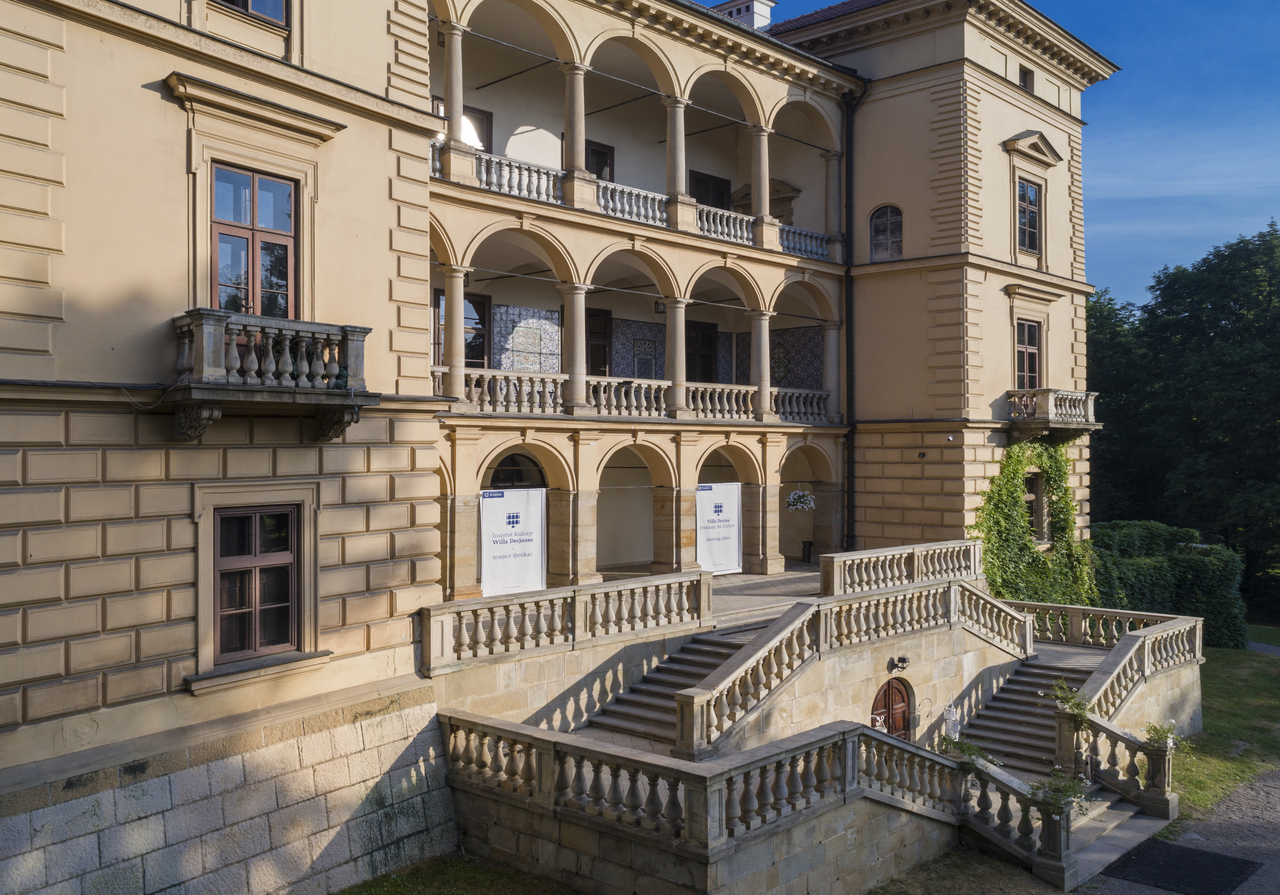
Villa Decius
Kraków, Poland
The Villa Decius Institute for Culture in Kraków, Poland, operates the Artists' Residencies Centre, hosting multiple residency programs for writers, translators, visual artists, scriptwriters, playwrights, and persecuted creators from around the world. Each program provides housing in comfortable rooms at the historic Łaski's House within the Renaissance palace-park complex, along with monthly scholarships, travel reimbursements, and opportunities for professional development and cultural engagement. Specific initiatives include the Krakow UNESCO Residency, ICORN for at-risk artists, Artistic Scholarship for visual artists focused on Polish heritage, and others like Arts in Exile for literature, visual arts, and music.
Browse by discipline in Kraków
Filter in Kraków
Been to a residency in Kraków?
Share your review