Artist Residencies in Rejmyre
1 residencyin Rejmyre, Sweden
Why Rejmyre is on artists’ radar
Rejmyre is a small glass-factory town in Östergötland, Sweden, and almost everything that matters for artists there orbits one thing: Rejmyre Art Lab. You don’t go for a gallery crawl or nightlife. You go to plug into a long-term, artist-run research project that treats the town, the glassworks, and the surrounding forest as material and context.
Think: quiet, rural, and slow-paced, but conceptually dense. The residency culture here is built around site-responsive practice, social and ecological themes, and embedded work with local people and institutions.
If your practice leans toward conceptual, contextual, or socially engaged work and you want to spend real time with one place, Rejmyre is a solid fit. If you’re looking for tech labs, non-stop openings, or big-city production infrastructure, this is not that kind of residency hub.
The residency ecosystem: how Rejmyre Art Lab actually works
Rejmyre Art Lab is an artist-run platform founded by artists Daniel Peltz and Sissi Westerberg. Instead of one fixed residency format, it runs a series of thematic, research-led programs over many years. These are a few core things to understand before you apply.
The Tropism residency: ecologies, growth, and long-form engagement
Tropism is one of Rejmyre Art Lab’s flagship international residency programs, structured around ideas of growth, orientation, and ecological interconnection. It uses the glass-factory village as a living laboratory for thinking about how organisms and humans respond to their environments.
Key features:
- Three-part structure
- Ensemble week – All selected artists gather in Rejmyre for meetings, collective exercises, workshops, and local site visits. This builds shared context and social cohesion so you’re not dropped into the town alone.
- Individual residency (around nine weeks) – Each artist returns for their own period in Rejmyre, working on a project while collaborating closely with either the local elementary school or the nursing home.
- Exhibition and public outcome – Each residency period ends in an open studio and public presentation. All participating artists later reconnect through a group exhibition.
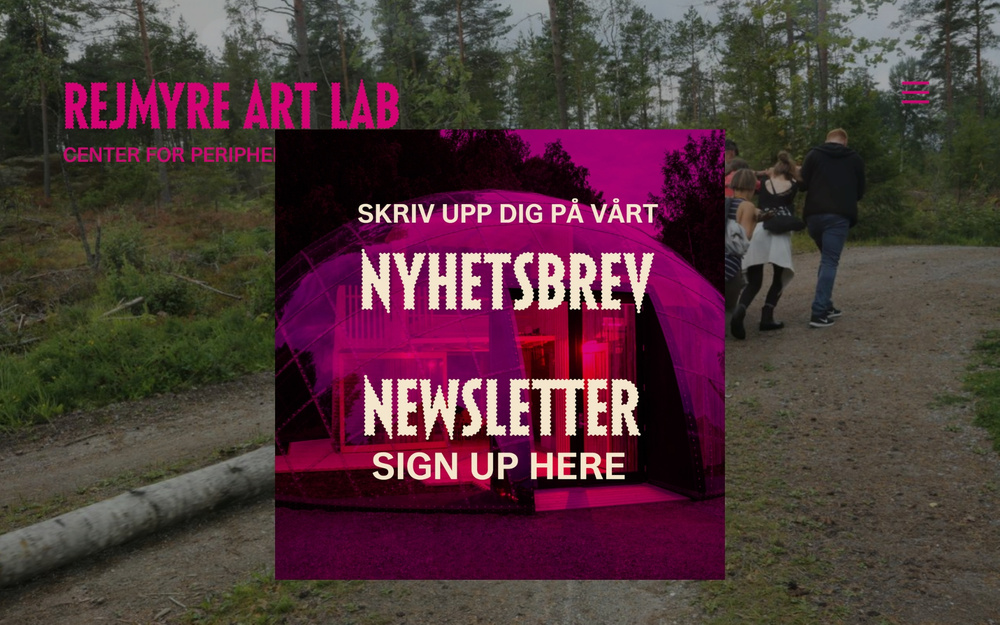
- The Refuging Pavilion as workspace – The core working site is a transparent, dome-like greenhouse structure in the middle of the village, called the Refuging Pavilion. It sits somewhere between studio, greenhouse, and public meeting place. Expect people to see what you’re doing.
- Social/ecological collaboration – The program explicitly asks you to build a project with either the local elementary school (grades 1–6) or the local nursing home. That can mean workshops, co-created installations, or long-form participatory projects, depending on your practice.
- Funding and support – Public descriptions of Tropism outline a work grant, a production budget, accommodation, travel reimbursement, and an exhibition fee. Exact amounts can vary by call, so always confirm against the current open call on the Rejmyre Art Lab site.
- On-site presence – The lab expects you to actually live in Rejmyre during your block. Ensemble week is mandatory, and during your individual residency there’s usually a limit to how long you can be away from the village.
Who this suits:
- Artists comfortable with long, research-heavy processes rather than fast production sprints.
- People who like working with communities (kids, elders, care workers) and are okay with their practice unfolding in shared spaces.
- Artists interested in ecology, plants, care, aging, education, or multi-species thinking.
- Practices that can adapt to rural infrastructure and don’t require highly specialized equipment on site.
Official info, structure, and current calls live on the Rejmyre Art Lab site: https://rejmyreartlab.cargo.site.
The earlier “Refuging” residency: how the lab thinks
Before Tropism, Rejmyre Art Lab ran residency cycles around the theme of “refuging” – asking how a glass factory town might shift into a place that produces refuge instead of just glass.
That program is useful context, even if that exact call is over, because it shows the lab’s method:
- Thematic focus – Refuging wasn’t just a word in the title; artists were asked to actively engage with refuge, hosting, and shelter as methods and subjects.
- Production plus reflection – Artists spent several weeks on site and then had a dedicated period for off-site reflection and post-production. The lab values thinking and aftercare, not just output.
- Ensemble plus individual time – Again, a collective residency period followed by individual work, echoing the structure of Tropism.
- Funding and housing – Calls listed a participation stipend, a production stipend, travel support, housing with individual bedrooms and shared spaces, and access to shared production areas in historic factory buildings.
The take-away: Rejmyre Art Lab tends to build slow, themed, research-informed residencies that mix group work, individual projects, and ongoing relationships with the town.
Beyond single residencies: an artist-run research ecosystem
Rejmyre Art Lab is more than one recurring open call. It also runs and hosts:
- International residencies that may be invitation-based or tied to specific themes.
- Post-MFA or fellowship-style programs for emerging artists.
- Glass and material experiments, drawing on the history of the Reijmyre Glassworks.
- Pedagogical projects such as Konstlabbet, working with youth and local participants.
- Exhibitions, seminars, and public programs at the venue Konsthallen Engelska Magasinet and in other local spaces.
If you’re interested in not just doing a one-off residency but building a longer relationship with a place, Rejmyre Art Lab is structured for that. It’s worth reading past projects on their site to see how artists have used the town as material – and to sense whether your own work would sit comfortably inside that ecosystem.
What Rejmyre feels like to work in
Rejmyre is small. That has pros and cons for a residency, and it’s good to be realistic.
Scale and pace
There’s a population of around a thousand people, surrounded by forests and lakes. You can walk most places you need to be. Noise and distraction are limited. This is ideal if you need mental space and want to see how your work lands in a very specific social fabric, not in a diffuse city crowd.
The flip side: there isn’t a big anonymous audience. People will know you’re the artist in town, and your interactions will often be personal and face-to-face. If your work thrives on that kind of relational intimacy, it can be powerful.
Glass, industry, and ecological context
The historical heart of the town is Reijmyre Glasbruk, a glass factory dating back to the early 1800s. Even if you don’t work with glass, the presence of that industry shapes how people talk, live, and think about making. For many artists, glass becomes a conceptual anchor: transparency and opacity, fragility, industrial craft, and labor history.
Just outside town, you’re immediately in forested areas and near lakes. For artists working with landscape, ecology, or multi-species worlds, Rejmyre is an easy place to wander, collect, record, and test ideas outdoors. Programs like Tropism explicitly encourage you to think about ecologies between people, plants, institutions, and everyday life.
Art venues and workspaces
A few key spaces show up in almost every residency description:
- The Refuging Pavilion – The dome/greenhouse used as a workspace and public interface. Expect a mix of studio time, plant life, and visitors. It’s good for installation, performance, workshops, and process-based work where the public can drop in.
- Konsthallen Engelska Magasinet – A former storage building turned cultural venue. The lab uses it for exhibitions and public programming. As a resident, you may present work here or attend events.
- Shared production spaces – Earlier calls mention communal production areas in historic factory buildings. Tools on site are limited, but the lab has a network of local and regional collaborators if you need specific equipment.
Practical note: do not assume a full-service fabrication center. If your project relies on heavy woodshop equipment, metal casting, or large-scale digital fabrication, either plan to bring what you can, keep the work modular, or coordinate with the lab and regional partners well in advance.
Living in Rejmyre during a residency
Most artists in Rejmyre are there because a residency brought them, not because they spontaneously moved to a tiny glass town. You’re likely to live in housing arranged by the program.
Where you’ll probably stay
Residency housing is usually:
- In or near the center of Rejmyre, close to project spaces.
- Organized as individual bedrooms with shared kitchen and bathroom.
- Set up to keep artists close enough that you actually meet each other and interact, especially during ensemble weeks.
If you are travelling independently (not via a residency), search for accommodation near the town center or ask Rejmyre Art Lab for suggestions. Staying near the lab, the glassworks, and the Refuging Pavilion matters much more here than choosing a specific “neighborhood.”
Cost of living and budgeting
Rejmyre is less expensive day-to-day than major Swedish cities, but you are still dealing with Swedish prices.
Typical costs to think about:
- Housing – Often included in residency programs, which removes the biggest expense.
- Food – Restaurants are limited; most artists cook. Expect to budget realistically for groceries.
- Transport – Inside Rejmyre, you can usually walk or bike (bicycles are often available). The main cost is getting to and from the town, which many funded residencies partially cover.
- Materials – Programs like Tropism offer production budgets, but it’s smart to plan for some out-of-pocket spending if your project needs specialized materials.
- Trips to larger towns – You may want occasional runs to nearby cities for supplies or exhibitions. Factor in bus or train fare.
When a residency offers a stipend plus production support, many artists can cover their time on site with careful budgeting. If the funding mix changes from call to call, adjust your expectations and financial plan accordingly.
Getting there and around
Rejmyre doesn’t have a big train station. Getting in usually looks like this:
- Travel by train or long-distance bus to a regional hub such as Norrköping or other towns in Östergötland.
- Use regional buses or a car from there to reach Rejmyre.
- Check SJ (national rail) and Östgötatrafiken (regional transit) for routes and schedules.
Once you’re in Rejmyre, walking and biking usually cover daily life. If your project involves transporting materials or visiting more distant partners, a car is helpful but not mandatory for every residency. Some artists coordinate occasional trips with staff, other residents, or local contacts.
Visas and residency length
The visa situation depends on your nationality and the structure of your stay.
- EU/EEA/Swiss artists – Usually do not need a work visa for shorter stays, but longer stays may involve registration depending on your situation.
- Non-EU artists – Need to check whether the residency classifies as cultural visit, work, or another category. A stipend or production grant does not remove permit requirements.
Residency hosts often provide invitation letters, but you are still responsible for having the right permit before you travel. Start with the Swedish Migration Agency (Migrationsverket) and confirm details with the host if needed.
Art community, public programs, and how to plug in
Rejmyre’s art scene is not about quantity; it’s about depth in one place. You are stepping into a long-running conversation between artists, local residents, and institutions.
How the community is structured
Key players and anchors include:
- Rejmyre Art Lab – The central artistic engine, programming residencies, seminars, and exhibitions.
- Reijmyre Glassworks – A historic glass factory that shapes the town’s identity and material culture.
- Local institutions – The elementary school and nursing home, where many residency projects take shape through workshops and collaborations.
- Konsthallen Engelska Magasinet – A cultural space where the lab hosts exhibitions and public events.
- Guest curators and researchers – For example, curators like Jonatan Habib Engqvist have been involved in programs such as Tropism.
Programming often includes:
- Open studios and public project sharings in the Refuging Pavilion or other spaces.
- Seminars and talks where artists, curators, and researchers present and discuss work.
- Workshops with local residents, often tied to residency themes.
- Group exhibitions that gather outcomes from multi-year projects.
As a resident, you’re expected to participate in this public-facing side. Your work will likely have some direct contact with people living in Rejmyre, not just visiting art audiences.
Seasonality: when it’s active and what the weather means for your work
Residencies and ensemble weeks often cluster in the brighter months, when it’s easier to travel, meet outdoors, and use the landscape. That said, Rejmyre’s winters can be powerful for more interior, reflective phases of a project.
- Spring and summer – Ideal for ecology-focused projects, outdoor workshops, and working in the Refuging Pavilion with plants and natural cycles as visible collaborators.
- Autumn – Still good for site-responsive work, with more introspective energy as days shorten.
- Winter – Less daylight, more solitude. Good for writing, editing, and deep studio time, but outdoor activity can be more demanding.
When you look at a specific residency period, imagine how your practice will feel in that season. If your work relies heavily on light, plants, or outdoor participation, earlier or later in the year may be better than mid-winter.
Is Rejmyre the right residency context for you?
Rejmyre tends to suit artists who:
- Want time and space away from big-city art cycles.
- Are interested in site-specific, relational, or socially embedded practice.
- Can work with limited tools but rich conversational and contextual resources.
- Enjoy collaborating with schools, elders, care workers, or local craftspeople.
- Are open to letting the town’s glass history, ecological setting, and social structures reshape their project.
If that sounds like your work, your next move is to:
- Read Rejmyre Art Lab’s past projects and residency calls in full on their site: https://rejmyreartlab.cargo.site.
- Look at the specific theme and expectations of the residency cycle that’s currently open.
- Ask yourself how your practice can genuinely respond to Rejmyre as a place, not just use it as a cheap studio for pre-existing work.
Approached that way, Rejmyre can give you a rare combination: deep focus, a clear thematic frame, and a long-term, artist-led research culture that actually cares how your project lands in the life of a small town.
Filter in Rejmyre
Been to a residency in Rejmyre?
Share your review